Groundcovers for sun are a bit trickier if we’re looking at the very low growing options. (A list of our taller groundcovers can be found at the end of this post.) Often the surrounding plants, being taller, end up shading these low growers, so they’re no longer in the full sun they prefer. This limits the list. Here are a few that do well at Catchfly Commons and attract a number of pollinators and other insects, including bees, flies, butterflies and skippers:
Antennaria plantaginifolia
Pussytoes
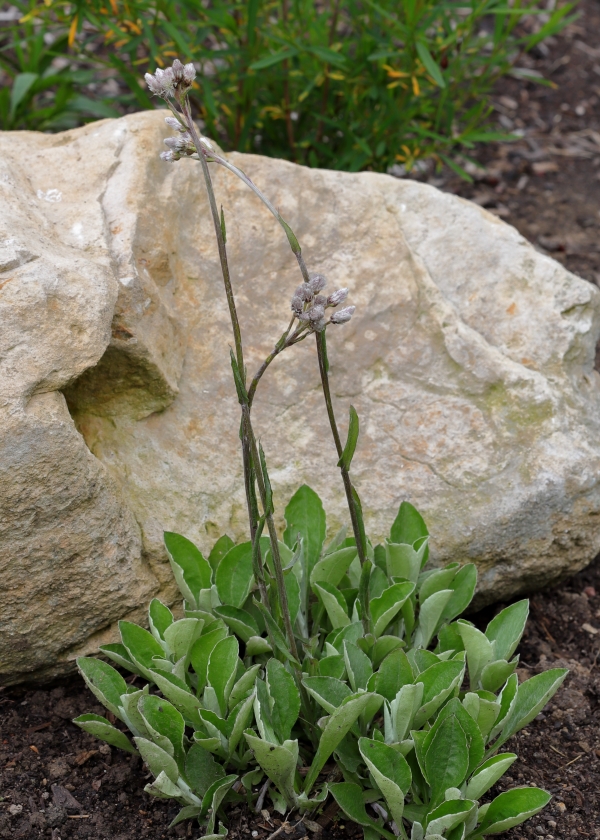
Pussytoes, members of the Asteraceae family, are a host plant for the American Painted Lady butterfly. The larvae depend on pussytoes, sweet everlasting, pearly everlasting and ironweed. Pussytoes are deer and rabbit resistant and grow well in full sun and medium to dry soil. The soft foliage hugs the ground and the bloom stalks reach about 12” in height. Pussytoes are native to much of the eastern U.S. although, surpisingly, not Ohio or Michigan.
Blephilia ciliata
Downy Wood Mint
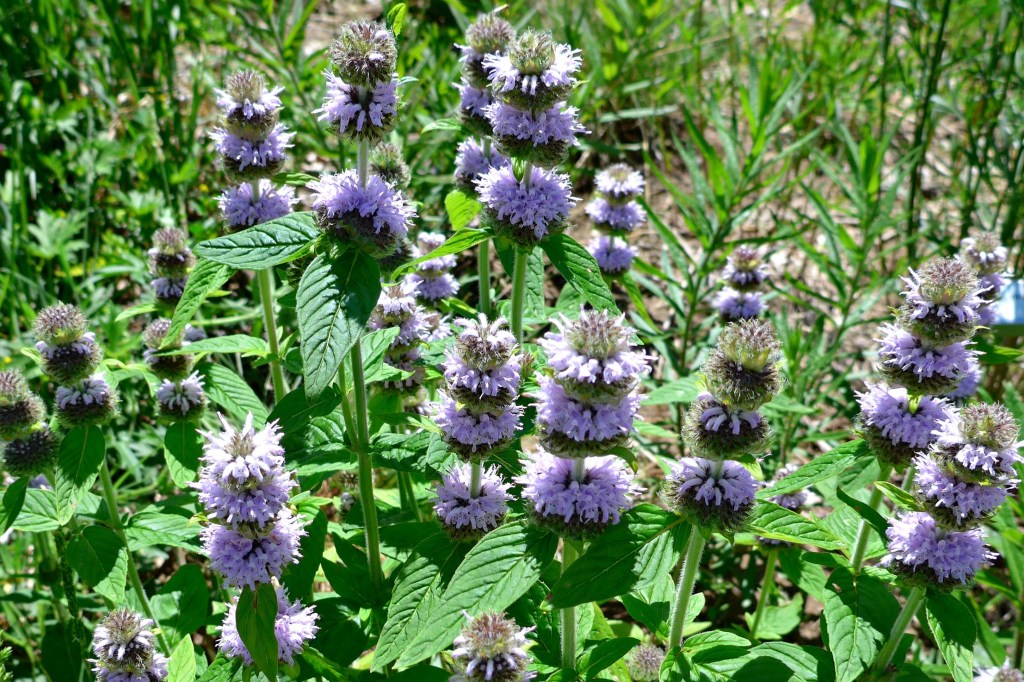
Downy wood mint spreads slowly by rhizomes to form neat clumps. A member of the mint family, downy wood mint is deer resistant and grows in full to part sun in medium to dry soil. This plant is sometimes called Ohio horsemint. Blephilia is Greek for eyelash, referring to the bracts being fringed by hairs. (1) Small basil leaves and shoots may remain green throughout the winter.
Callirhoe involucrata
Winecup

This striking groundcover can form dense mats and is happy to wander between, and even over, other plants. This member of the mallow family is native to states west of Illinois and south to Texas. Winecup has a taproot so may be difficult to transplant but it grows well from seed and seedlings are easy to move. This is a host plant for the gray hairstreak and painted lady butterflies. Winecup was a preferred meal for rabbits at Catchfly Commons. We enclosed one plant in fencing which allowed it to thrive and it was happy to climb and encircle the fence. Seedlings growing outside the fence were not bothered by rabbits this season, so perhaps we can grow it in a few additional beds.
Packera aurea
Golden Ragwort
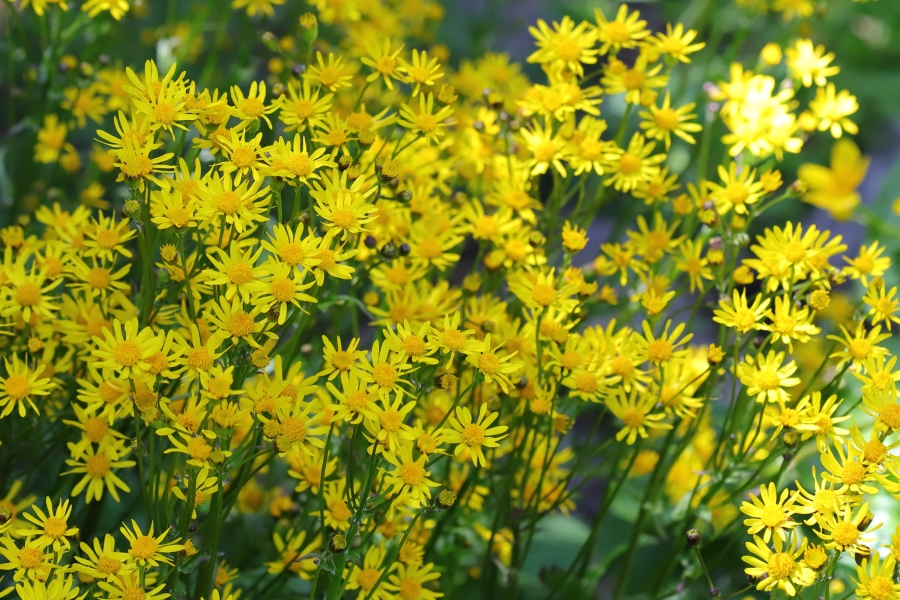
Golden ragwort provided a quick, dense groundcover when a massive new bed was installed at Catchfly Commons and we wanted plants to form a living mulch ASAP. They seemed to grow equally well from rhizomes as from seed. In subsequent years we began cutting it back before seeds ripened and took plants out in an area where we wanted to plant native pachysandra. In full sun it requires a site with adequate moisture. The Andrena gardineri bee specializes on pollen from ragworts.
Salvia lyrata
Lyreleaf Sage
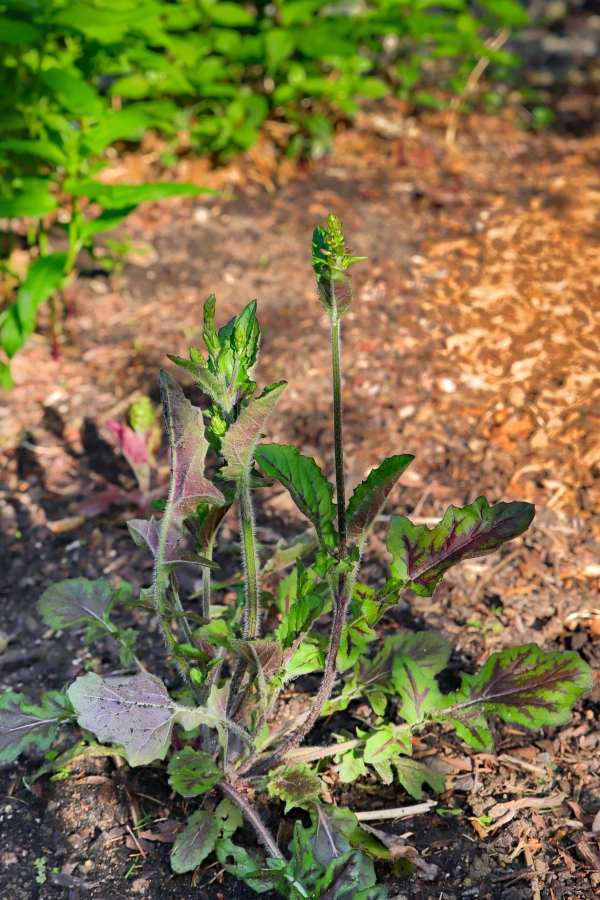
Salvias are in the mint family, Lamiaceae, and lyreleaf sage has the square stems indicative of the family. It can become a groundcover pretty quickly as it self-seeds abundantly. The burgundy veins are unusual but fade, sometimes completely, in shade. I enjoy this as a groundcover, especially after cutting back the bloom stalks, when the foliage can really shine. However, these plants live to reproduce so new bloom stalks appear almost immediately. The blooms are visited by bees and other insects, and also hummingbirds.
Symphyotrichum ericoides
‘Snow Flurry’, Snow Flurry Heath Aster

Heath aster grew rangy and aggressively in our border but Snow Flurry heath aster is another animal entirely. (You know what I mean.) It’s an excellent groundcover in full sun and thrives in dry soil, like where it’s growing here in a 2’ strip between a blacktop driveway and a sidewalk. Yes, it gets quite dry. Chicago Botanical Garden gave Snow Flurry heath aster the highest rating possible in a trial of asters for flower coverage and mildew and rust resistance. The plant can grow to 8” with a spread of four feet. It forms a dense mat so if any weed seeds beneath it germinate, they are starved of sunlight and perish.
Viola sororia
Common Blue Violet
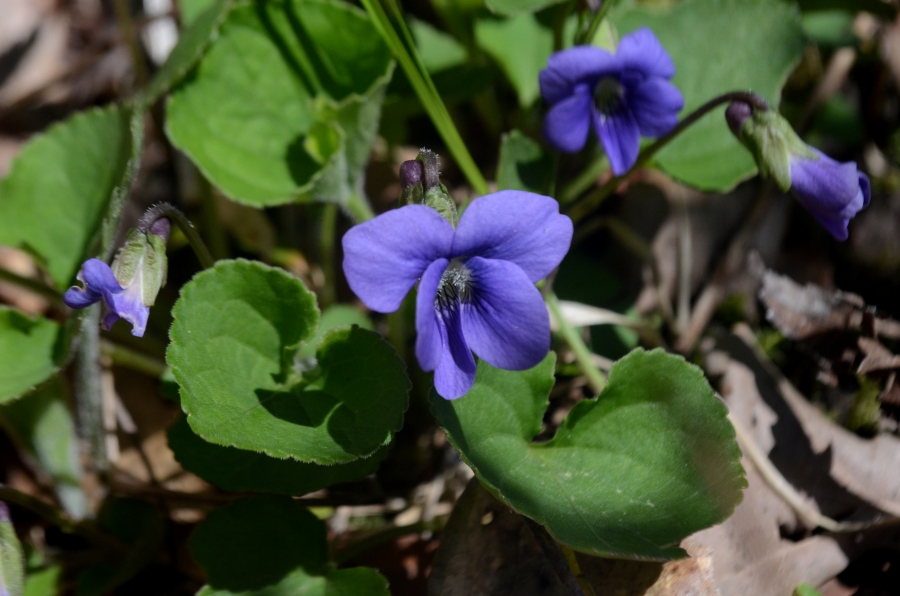
There are roughly thirty species of violets native to Ohio. Common blue violet is seen by some homeowners as a weed because it can grow happily in the lawn. It has value to wildlife as a host plant for Edward’s fritillary, great spangled fritillary, Mormon fritillary, and variegated fritillary butterflies. It is also host plant for a pollen specialist bee, the Andrena violae. Violets can form a dense mat and grow in full sun with adequate soil moisture. “Pollinated flowers result in a normal seed distribution like most flowering plants; however, Viola sororia produces seeds in the late summer from a process called cleistogamy. This means that it self-fertilizes inside the plant, without opening.” (2)
Taller Groundcovers
From Part I: Groundcovers shade out and (hopefully) outcompete weeds, help moderate soil temperatures, and keep the soil surface from drying out. Their root systems can help stabilize soil, and a matrix of groundcovers can form an aesthetically pleasing foundation or front layer for other garden plants, both herbaceous and woody.
Aside from layering (short plants in front, tall plants in back), groundcovers aren’t necessarily short. Here are some native plants that serve the functions of groundcovers at Catchfly Commons but are taller:
Height: 1-3 feet
- Anemone canadensis, Canada Anemone
- Carex vulpinoidea, Brown Fox Sedge
- Conoclinium coelestinum, Hardy Ageratum
- Rhus aromatica, Fragrant Sumac ‘Gro-Low’
Height: over 3 feet
- Helianthus divaricatus, Woodland Sunflower
- Helianthus mollis, Downy/Ashy Sunflower
- Monarda didyma, Bee Balm ‘Jacob Cline’
- Pycnanthemum muticum, Short-tooted Mountain Mint
Photos by Randy Litchfield unless otherwise noted
© Randy Litchfield, some rights reserved (CC-BY-NC)
(1) “Blephilia ciliata,” Missouri Botanical Garden, https://www.missouribotanicalgarden.org/PlantFinder/PlantFinderDetails.aspx?taxonid=281528&isprofile=0&letter=B
(2) “Viola sororia,” Wikipedia, https://en.wikipedia.org/wiki/Viola_sororia#:~:text=These%20pollinated%20flowers%20result%20in,inside%20the%20plant%2C%20without%20opening
 Catchfly Commons