Our witch-hazel has been in bloom for a couple of weeks (late January and early February). The fact that it is blooming now is a clue that it is Hamamelis vernalis rather than Hamamelis virginiana, which blooms in the fall.
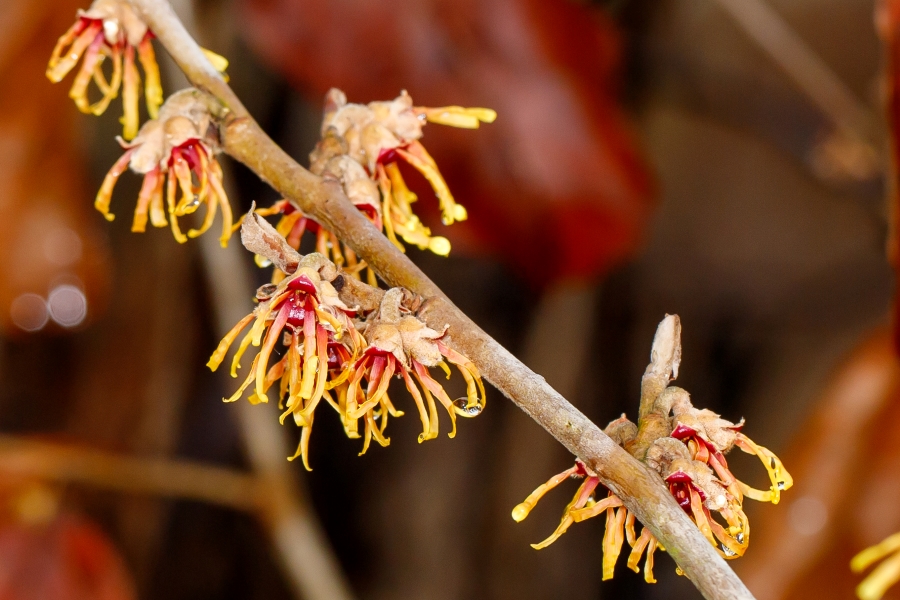
Witch-hazels are nifty plants. Extracts from witch-hazels are mildly astringent and their forked-branches have been used to divine underground water. (1) Witch-hazels are in the Hamamelidaceae family along with Fothergilla gardenia and Fothergilla major. The leaves in this family have beautiful fall color.
Vernal (Ozark) Witch-hazel
Lady Bird Johnson Wildflower Center describes vernal witch-hazel as “[a] small tree or large shrub to 15 ft. tall with multiple, crooked stems forming an irregular, open crown.” They also note that the petals of blooms roll up on harsh cold days to avoid freeze damage. Vernal witch-hazel wants part shade and medium water. In terms of soil, vernal witch-hazel prefers acidic conditions and can handle “gravely to clay soils.” (2)
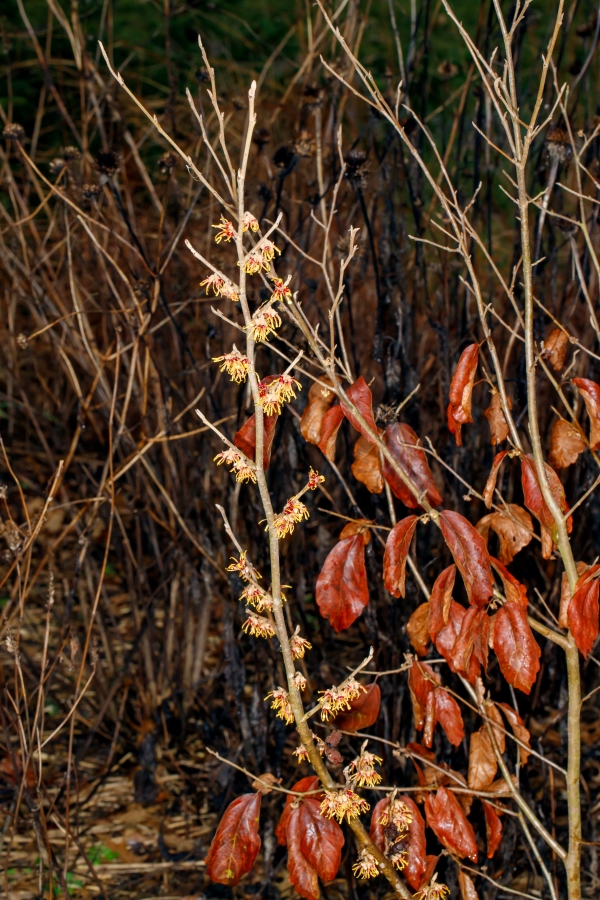
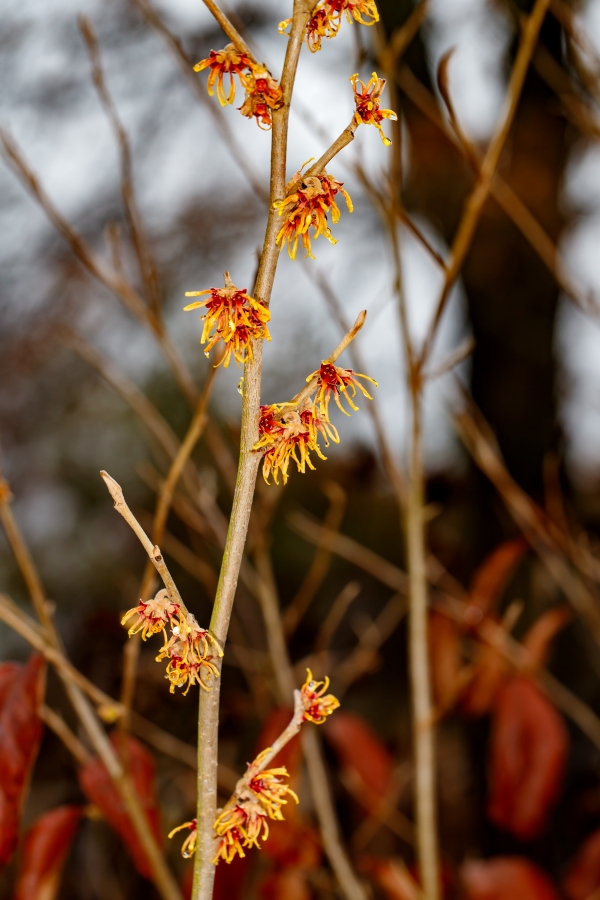
We have had our vernal witch-hazel for several years. This species is slow growing and it probably does not help that the soil in our area is alkaline rather than acidic. Last year was the first year we saw a good number of blooms and this year is certainly the best so far. Interestingly, half the plant bloomed in November-December and half is now in bloom. Vernal witch-hazel tends to hold its leaves through winter. Sometimes this means that blooms are obscured.
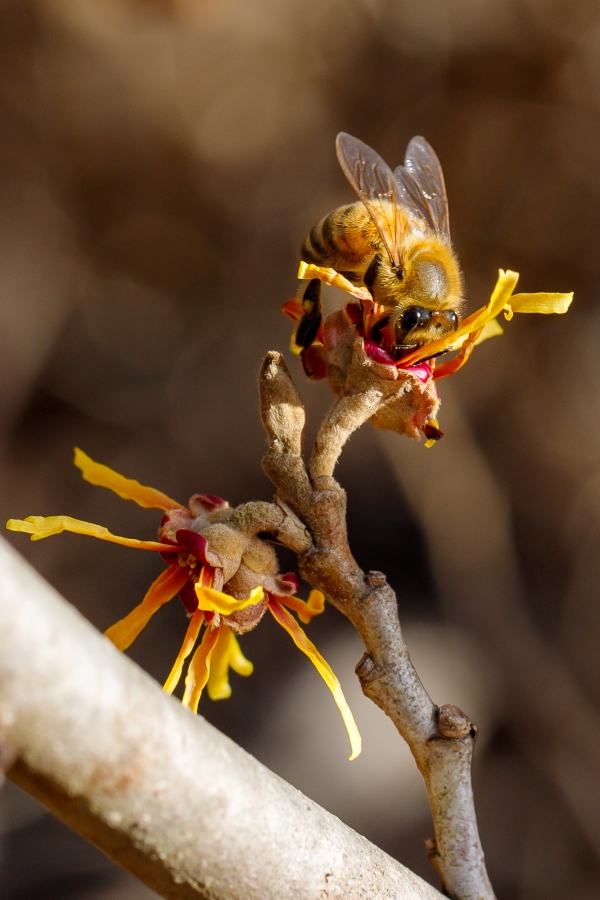
Because it blooms so early, bees that become active on warmer winter days are the ones most likely to visit. Most likely that means honey bees and possibly some bumble bees.
What is Vernal Witch-hazel Doing at Catchfly Commons?
Vernal or ozark witch-hazel is a US native shrub, however it is not native in Ohio. According to BONAP, the native range of Hamamelis vernalis is Missouri, Arkansas, Louisiana, Oklahoma, and Texas.
If vernal witch-hazel is not native to Ohio, then what is it doing at Catchfly Commons? We like the bloom and foliage of witch-hazels (fothergilla as well), but we also want to increase blooms in the landscape earlier in the year. Vernal witch-hazel is one of the earliest blooming shrubs, while the Ohio native common witch-hazel is a fall bloomer. In this case, the bloom time of a plant became more important than its native range.
This raises issues about intentional landscape goals and about how “pure” one intends to be with their native plant gardening. For some, vernal witch-hazel would not be an option because it is not native in Ohio. There are good reasons for that position: foreign growing conditions for the plant, uncertainty of whether eco-services are provided by the plant in new ecosystem, and potentially negative implications for local native plants. Common witch-hazel (Hamamelis virginiana) would be the way to go.
We are comfortable with the choice to have a vernal witch-hazel in Catchfly Commons. We have an intentional purpose for increasing early spring blooms. As a fall bloomer, common witch-hazel would only add to our extensive fall blooms. Our particular vernal witch-hazel plant was propagated by Dawes Arboretum from the collection (east central Ohio) and purchased at their plant sale. This provides some conditioning to Ohio climate. By the way, Dawes has a very nice collection of witch-hazels. Also, the number of non-Ohio native plants in our landscape is small, so we have a high level of eco-function in the overall landscape. To maintain this, we use non-Ohio plants sparingly. Finally, vernal witch-hazel is a mid-US native and we would not have chosen it were it from the west coast, outside the US, or a cross species cultivar.
The point here is not to be defensive about this plant selection, but to highlight that those who garden with native plants have choices to make in plant selection. To make those choices it is important to be intentional about one’s commitments, approach, and purposes.
Common Witch-hazel
The witch-hazel native to Ohio and the eastern half of the US is Hamamelis virginiana (common or American witch-hazel). The appearance of Common and Vernal Witch-hazel are very similar. Both prefer acidic soils but common witch-hazel is less tolerant of alkaline conditions. Common witch-hazel blooms later in the fall while vernal witch-hazel is a late-winter to early spring bloomer.
The Illinois Wildflower site has a helpful entry on common witch-hazel.
References
(1) “Hamamelis virginiana,” Plant Database, Lady Bird Johnson Wildflower Center, accessed 2.6.2024, https://www.wildflower.org/plants/result.php?id_plant=HAVI4.
(2) “Hamamelis vernalis,” Plant Database, Lady Bird Johnson Wildflower Center, accessed 2.6.2024, https://www.wildflower.org/plants/result.php?id_plant=HAVE2.
Photos by Randy Litchfield unless otherwise noted
© Randy Litchfield, some rights reserved (CC-BY-NC)
 Catchfly Commons