Hairy Bittercress or Lesser-Seeded Bittercress?
Don’t take your eyes off the ball! A ubiquitous weed in our landscape is hairy bittercress, Cardamine hirsuta. Now begins the time of year for scouting these tricksters, just as much of the gardening work winds down. The first time I saw this plant in our landscape beds was probably 10 or more years ago. I thought the basal rosette was attractive, and as there were only a few plants, I didn’t give them much notice. Fast forward to now and they are in most of the beds that get at least some sun. Seeds germinate just about any time, early spring through fall, mature quickly, and have no trouble surviving winter so several generations can be produced in a year. When I went out to pull a plant for this entry, the first plant I saw had already gone to seed. So much for early scouting! Each plant produces several to many very small flowers, each of which can produce up to 600 seeds. Seed pods are dehiscent and seeds can be flung up to 16 feet from the plant upon the pod bursting. In fact, another common name for this plant is shotweed. I guess this explains them appearing all over the yard in a matter of a few years. Unfortunately, plants also grow in our lawn.
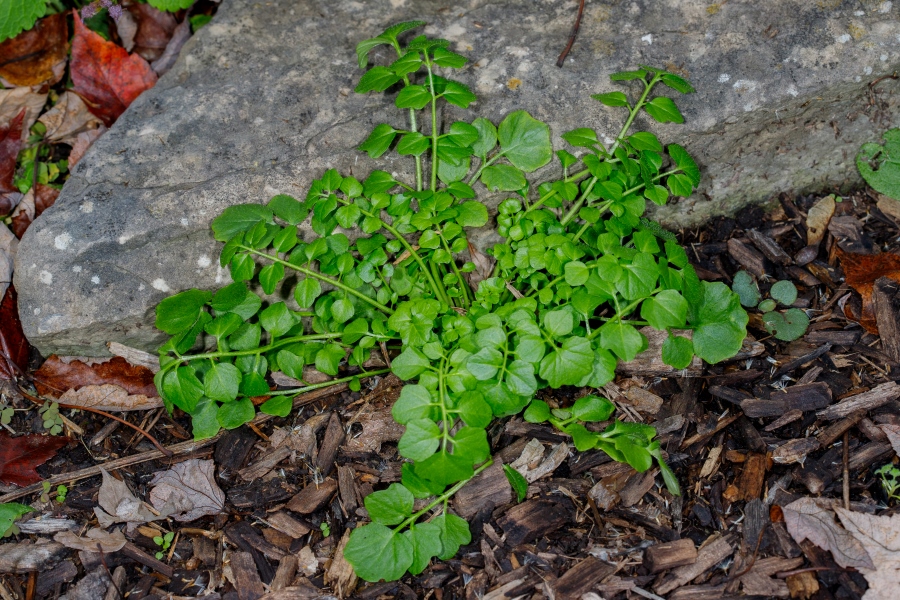
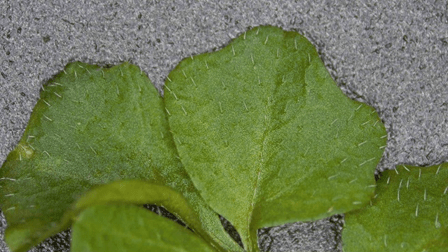
For a long time I was convinced that this was lesser-seeded bittercress, Cardamine oligosperma, because (1) all plant surfaces appeared smooth with no hairs visible, and (2) it matched the photo and description in Weeds of the Northeast.1 The entry for lesser-seeded bittercress said it was a “new introduction” in the northeast so I thought if it was new in the northeast by 1997, it could easily be the species I was seeing now in central Ohio. It turns out that lesser-seeded bittercress may have been new to the northeast in 1997 but according to BONAP, it is native to several western states, Colorado, Wyoming, and Montana, and on west to the coast. Of the thousands of hairy bittercress plants I have removed over the years, none ever appeared to have hairs anywhere on the plant. The entry for hairy bittercress states that hairs are often found on the leaf surfaces, where, I would think, they would be quite evident. I brought in a sample to determine that what we have is hairless. Imagine my surprise, then, when under the microscope, hairs are quite visible on the upper leaf surface (see photo, below). These are not visible with the naked eye, and there are relatively few of them, but they are clearly present. I then asked Randy to take a photo using his macro lens, and sure enough, the hairs are apparent (see photo below).
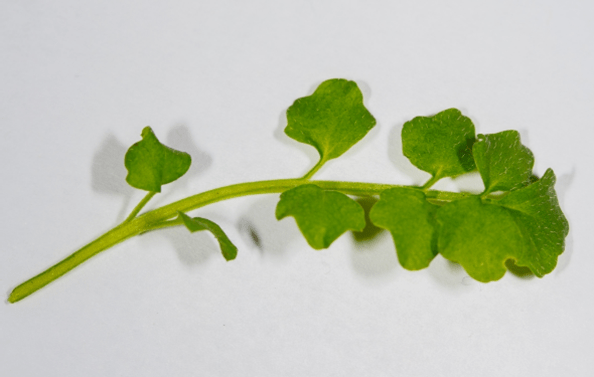
Sara Gage wrote a piece for Washington Native Plant Society called “Shoot! It’s Shotweed!” In it she references Eugene Kozolff’s book, Plants of Western Oregon Washington & British Columbia. “The morphological character used by Kozloff to separate the two taxa is the shape of the tip of the fruit, a good character but requires mature fruits. The two species can also be separated by stamen number, nearly always four stamens for C. hirsuta and six for C. oligosperma.”2 I don’t see any blooming plants right now but as soon as early blossoms appear, I will be counting the stamens.
The genus Cardamine (the bittercresses or toothworts) is an important one in our garden. We celebrate when the first cutleaf toothwort, Cardamine concatenata, appears in the spring, one of the earlier blooming plants at Catchfly Commons. It self-seeds so increases its presence a bit, year after year. A recent post on groundcovers for shade featured crinkleroot or two-leaved toothwort, Cardamine diphylla. One of its distinguishing characteristics is a root that can be used as a flavoring, similar to wasabi.
Ohio is home to eleven native Cardamine species. In addition to the two species described above, the following species are included in ODNR’s Ohio Native Spring Wildflower Checklist: American Bittercress (Cardamine rotundifolia), Purple Cress (Cardamine douglassii), Slender Toothwort (Cardamine angustata), and Spring Cress (Cardamine bulbosa).
Although we remove as many hairy bittercress plants as possible, and as soon as possible, there’s one consolation regarding the plants we miss. A specialist bee, the Andrena arabis, is dependent on plants in the Cardamine genus. These mining bees collect pollen exclusively from the cardamines. So perhaps the hairy bittercress blooming in the grass or the landscape beds help maintain a population of these bees.
References
1Uva Richard Hart Joseph M DiTomaso and Joseph Crowell Neal. 1997. Weeds of the Northeast. Ithaca: Comstock Publ. Associates.
2Kozloff Eugene N. 2005. Plants of Western Oregon Washington & British Columbia. Portland Or: Timber Press.
Photos by Terri and Randy Litchfield unless otherwise noted
© Terri and Randy Litchfield, some rights reserved (CC-BY-NC)
 Catchfly Commons